
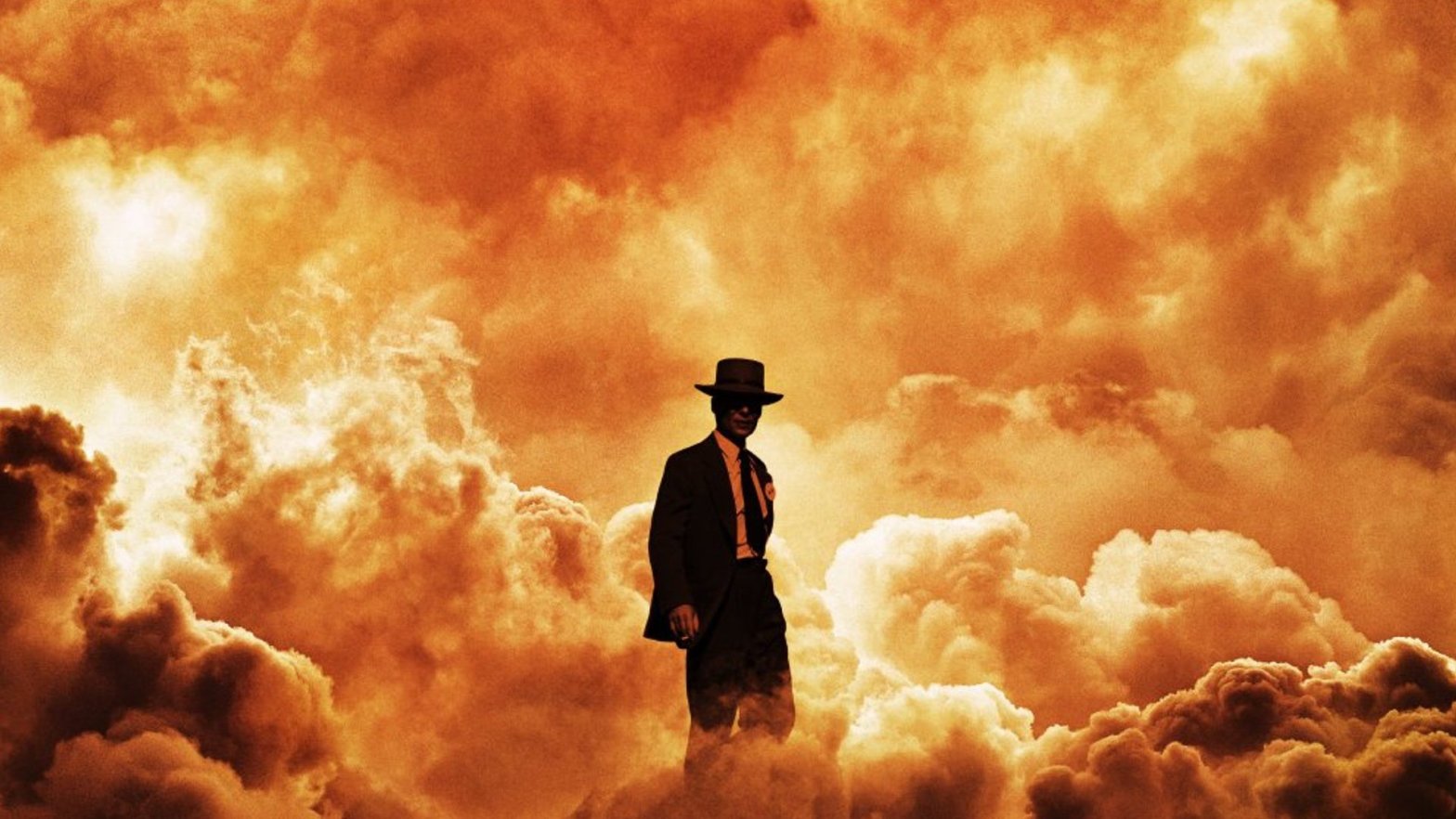
I so want to love Christopher Nolan’s Oppenheimer, the ‘American Prometheus’ who leads the US’s colossal scientific endeavour to build an atomic bomb during the Second World War.
Prometheus, the God of Fire, is best known for defying the Olympian Gods by stealing fire and giving it to humanity.
It’s a stellar analogy.
As for Oppenheimer’s fire, the reality is that the Nazis surrendered, long before atomic bombs were a reality on either side. Bombing the defeated Japanese at Hiroshima and Nagasaki was merely to cow the Russians with a ruthless demonstration of the US’s nuclear mastery post-war. Politics, eh.
To experience that moment of darkest history through Oppenheimer’s eyes is surely what a biopic is all about.
I sit back in my reclining seat, eyes wide, ready to feel the intensity of emotion, adrenaline and terror. To understand the complex, tortured psyche of the man who utters the words “Now I am become Death, the destroyer of worlds” as he witnesses the first detonation of a nuclear weapon.
The writer in me wants to have written the story.
The Soviet Intelligence had a codename for Oppenheimer’s plan – Enormoz.
This was Nolan’s attempt at building ‘Le Filme Enormoz.’ Le Bafta Enormoz.
A giant study of the horror of detonation. Oppenheimer portrayed as the haunted driving force behind humanity’s power to destroy itself.
Cillian Murphy fills the screen, literally, with Nolan’s trademark IMAX 70mm shooting which fills the senses of the audience. A gaunt physicality that begs you to be ripped apart by emotion and turmoil.
It’s said that Nolan does not allow chairs on set. If people are sitting, they are not working. They are not connected.
Murphy reportedly ate only an almond a day for weeks in order to lose weight. Eyes set in a gaunt skull that oozes solitude and emotional imprisonment.
The main event is that terrifying first demonstration, the Trinity Nuclear Test, in the New Mexico Desert in July 1945. The biggest, most overwhelming, and terrifying of big bangs.
But, but, but…… I shift in my seat, my eyes blink…. I slug my diet coke……
Mr Nolan, you are a lazy writer. And an egoist. You want to create a clever, mind-bending film, bewildering us with complex narrative and cinematic technique.
NOOOOOO
Mate, you completely forgot about developing the characters.
Oppenheimer’s beginnings as a young scientist, lonely and unhappy. His relationship with anti-fascist ideology and the damaged, multi-layered women who seed into his life are nothing more than window dressing. “Do you really think we should be doing this,” he clunkily asks the Atomic Energy Commission Chairman, Lewis Strauss. The first law of character development – show, don’t tell. I shift uncomfortably in my seat.
I cringe again when, post Hiroshima, addressing an audience of cheering colleagues and subordinates, Oppenheimer’s angst and horror at what he’s done is represented by a fatuous comment about reckoning the Japanese “didn’t like it.” Ugh. Poor writing. Lazy exposition.
Again, in the infamous scene between Oppenheimer and Harry S Truman (played by the brilliant Gary Oldman), Oppenheimer’s disquiet is laid out for us in a mumbled “blood on my hands” sequence. Cringey.
I am not alone. There have been a few critics amongst a tide of Bafta-certainty-sycophancy. None of them nail it though.
“No women speak for the first twenty minutes of the film,” says one critic. Rightly pointing out that the two complex women central to Oppenheimer’s psyche are portrayed as “blow up dolls” with no character other than an ability to hang out washing and drink martini’s stage-left.
A well-known newsreader criticises Oppenheimer for dialogue that can’t be heard. Apparently, it’s an artistic choice Nolan makes for all his films. He doesn’t have his actors return to the recording studio post-production to recapture dialogue so we can hear it. He prefers the performance that’s given in the moment.
Others criticise the flawed science. Nuclear experts say the film is epic, intense, compelling – but not always accurate. Apparently, even from safe-distance-plus, the Trinity Test would be eye searing and like opening a roasted oven door.
These are symptoms of my problem with Christopher Nolan films.
Basically, it boils down to the fact that he’s not interested in telling Oppenheimer’s story. He wants to bend your brain with cheap tricks and be lauded for it. Like his other films: Batman; Memento; Inception; Tenet; Interstellar.
The story and the people are lost in non-linear, overly complicated narrative. And without the characters, there is no compelling narrative. We just have some wibbly-wobbly brain shaking through jumping time dimensions, close-up pictures and inaudible dialogue. Oh, and an impressive bang.
The biggest flaw? Cillian Murphy is outshone by the real character of the film, time. Oppenheimer is about time. There is a weird encounter with Allbert Einstein that feels entirely disconnected. You feel it’s only added to enhance the non-linearity of time and space. You feel baffled and know you’re going to have to watch the film several times over to unravel it.
In most of Nolan’s films, time is not just a facet of the film, it’s the foundation of his ideas.
Oppenheimer is no different. The film moves back and forth in time. Mind-bending, non-linearity either side of the 1945 firebreak. You only know kinda where you are because of Oppenheimer’s clothes and whether you’re in court or on a desert. The version of Oppenheimer we see at any given time is a marker, an indication of which timeline we are currently inhabiting. The aim is to use convoluted time trickery and an epic big bang to create a subconscious result on characters and audience.
To Nolan, a straight line is never the optimal distance between two points.
The result is a film that could have and should have been something more than it is.
The human brain is designed to connect. To be human is to empathise with another’s situation. We see what Oppenheimer sees at the same time he sees it. We mirror and feel his emotional reaction. The same bits of our brain light up. We experience it as if we were the man, himself. Psychologist’s call is Simulation Theory. We make sense of others by connecting as one brain, activating the same mental processes as them, seeing and feeling the world exactly as they do, or have done.
Now that’s immersive theatre. It packs a punch and sends us away feeling that we’ve been part of something special, something profound.
That’s what I want from my films.
Storytelling without character development is not storytelling. It’s ego.
Mr Nolan, sir. If you are presented with such an immense and important story again, I know a great writer who should join your team. Small, red-haired, feisty, Scottish. Shit-hot at developing complex characters.
She likes a comfy chair though… and some cake.
The name’s Lloyd. Lauren Lloyd.
Together we’d make a truly epic, immersive movie that packs a profound punch.
Simulation Theory. To feel what our protagonists feel as they feel it. Is that not what we all want from cinema?
 Lauren Lloyd